Research
Body weight as a dimension of inequality in the United States
Body weight has become a central criterion by which health and wellbeing are assessed — and contested. My dissertation used a mixed-methods approach to examine the contexts in which body weight is defined or constructed as a health risk, with a focus on the uncertainty that pervades both research and clinical practice. One chapter, examining how pediatric clinicians navigate the diagnosis of childhood obesity, was published in Social Science & Medicine. My related quantitative work on this issue documents educational variation in the association between central obesity and premature mortality, finding that the relative harmfulness of obesity is paradoxically higher among college-educated adults — likely owing to a relative absence of competing risks — published in Social Science Research. I am particularly interested in the emerging phenomenon of GLP-1s as a promising — if uncertain — population health intervention.


Definition and conceptualization of health and the social determinants of population health
Critical sociological theory on the social construction of health is invaluable for advancing clinical, biomedical, and population health research. Several of my papers take up questions about how health is defined and measured, and what is at stake in those definitional choices. In a highly-cited paper published in Social Theory & Health, I argue for a more holistic — and less diagnostic — approach to body mass index in research and clinical practice. A related paper in Sociology of Health & Illness addresses the conflation of "unhealthiness" and "riskiness" in how BMI and obesity are used in research. My paper in Medical Humanities demonstrates how the biological reification of race in biomedical research contradicts the stated commitments of many scientists to racial health equity. A more recent publication, also in Sociology of Health & Illness, considers the promises and perils of adopting "social determinants of health" as a diagnostic category in medicine, showing how its varied meanings lead to very different conclusions about who is responsible for improving population health and by what mechanisms. Finally, a recent co-authored paper, also in Sociology of Health & Illness, examines how elite class self-interest shapes socioeconomic inequality and, in turn, U.S. population health — connecting macro-level political economy to the social determinants framework.

Measurement and modeling in
population health research
I use theoretical critiques of health conceptualization to inform empirical work on measurement and modeling in population health research. Working with Dr. Ken Bollen, I have examined measurement error in self-rated health and tested competing longitudinal models of health trajectories, with papers in Social Science Research and Demography. I am also first author on a paper in Social Science & Medicine developing and validating a multidimensional latent measure of despair — capturing emotional, cognitive, behavioral, and biosomatic indicators — and examining its association with substance use and suicidality in midlife. A subsequent research note in Demography (with Lauren Gaydosh) shows that this latent despair construct predicts drug-related and suicide mortality at the individual level, lending further validity to despair as a meaningful construct for understanding "deaths of despair."

Distal and proximate determinants of health and mortality in the United States
Much of my empirical work examines the social, economic, and political determinants of population health and mortality in the United States — spanning proximate individual-level factors and more distal structural and policy contexts.
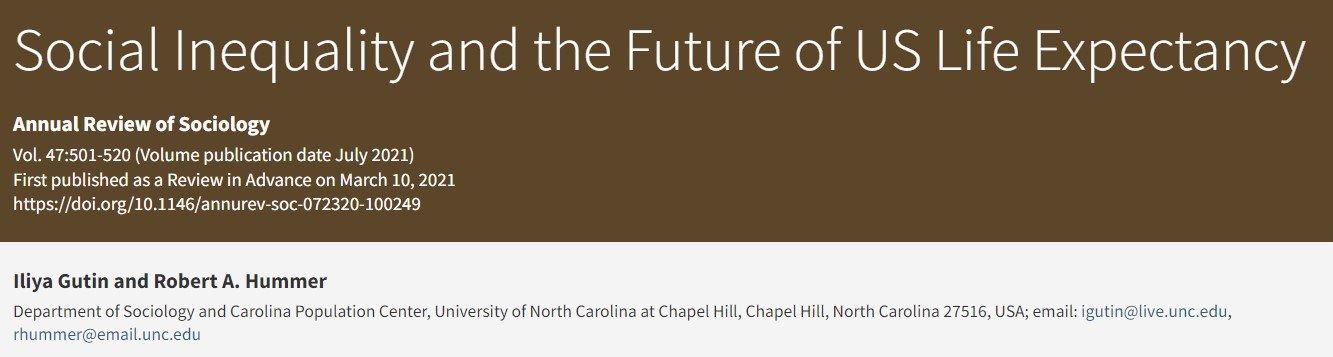
At the individual level, I have studied how occupation and employment status shape working-age mortality risk, finding elevated risks for drug-related deaths across a broad range of service, manual labor, and white-collar occupations, as well as among those not working — published in Preventive Medicine. Other work has documented racial disparities in early-life mortality (in Demography), geographic variation in early-life mortality (in Demographic Research), and financial loss as a mediator between education and harmful health behaviors (in SSM-Population Health). With Dr. Robert Hummer, I authored a contribution to the Annual Review of Sociology providing a critical overview of what social inequality and emerging threats portend for the future of U.S. life expectancy.
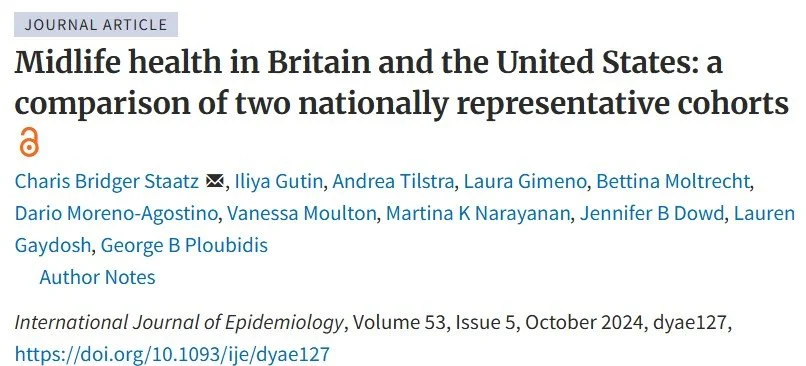
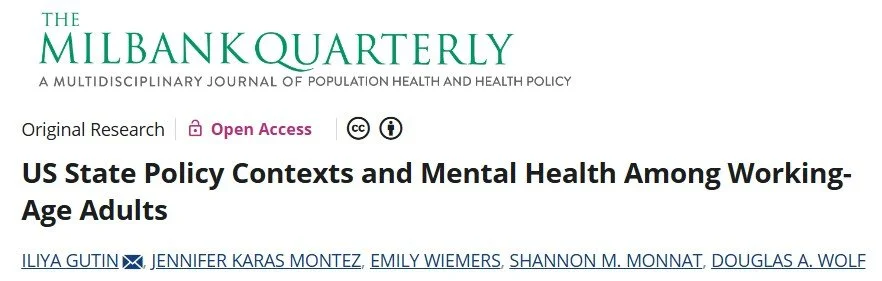
More recently, my work has turned to the structural and political contexts that shape population health. A series of collaborative projects — using county- and state-level data spanning several decades — examines how state policy environments and local economic conditions jointly contribute to geographic disparities in working-age mortality, with papers forthcoming in Demography and the Russell Sage Foundation Journal. Related work published in The Milbank Quarterly documents the association between state policy contexts and mental health among U.S. working-age adults from 1993 to 2022. Complementing this U.S.-focused work, a collaboration with researchers at Oxford, UCL, and UNC uses the U.S. Add Health and British BCS70 cohorts to compare educational gradients in health at midlife across the two countries — asking why lower education is particularly harmful to health in the United States. This work appears in the International Journal of Epidemiology, with a more in-depth analysis forthcoming from the Russell Sage Foundation.